Online UPSC Coaching in India: How to Choose in 2026, With Fees, Formats and Free Daily Practice
Short answer: Online UPSC coaching works if it gives you three things a book cannot: a fixed schedule, regular tests with real evaluation of your answers, and someone to ask when you are stuck. Recorded courses from large national providers start around ₹50,000 for a full GS programme, and live online programmes run from about ₹60,000 to more than ₹1.5 lakh. Before you pay for anything, use the free material that UPSC, NCERT and PIB publish, and take a free trial test to see if a provider’s questions and explanations suit you.
By Prayag IAS Academy, Dehradun · Updated 18 November 2026 · Fee ranges checked on 18 November 2026
Key takeaways
UPSC Civil Services Prelims 2027 is scheduled for 23 May 2027, with the notification due on 13 January 2027 (UPSC calendar). That leaves about six months from today.
The format matters less than the feedback loop: weekly tests, checked answers and a mentor who reads your mistakes.
Recorded, live and hybrid courses differ mainly in price and discipline. A recorded course is cheaper but needs more self-control.
Hindi-medium aspirants should check that tests, explanations and answer evaluation are all available in Hindi, not just the videos.
Prayag IAS Academy publishes a free daily current affairs quiz in Hindi and English that anyone in India can take, every day, without signing up.
Why are so many aspirants choosing online UPSC coaching?
Dholpur House on Shahjahan Road, New Delhi, the headquarters of the Union Public Service Commission. Photo: Ramesh lalwani, CC BY-SA 4.0, via Wikimedia Commons.
Ten years ago, serious UPSC preparation usually meant moving to Old Rajinder Nagar or Mukherjee Nagar in Delhi, or to a coaching town like Prayagraj, Jaipur or Dehradun, and paying rent on top of fees. Today a student in Kohima, Kollam or Kota can watch the same lectures on a phone. That is real progress. It also means the choice has become harder, because every provider now claims to be the best.
This guide does not rank institutes. Instead it shows you what to compare, what things cost on providers’ own pages, what you can get free from the government, and how to test a course before you pay. We are a classroom institute in Dehradun, running since 2000, and we have watched many students waste a year on the wrong course. The checks below come from that experience.
What types of online UPSC coaching are there?
There are four common formats. Here is how they compare:
Format
How it works
Best for
Watch out for
Recorded online
Pre-recorded lectures you watch at your own pace, usually with notes and tests
Working professionals, students in college, people on a tight budget
Easy to fall behind; check how often tests and doubt sessions actually happen
Live online
Scheduled classes over video, with chat or voice questions
Students who need a timetable but cannot relocate
Batch size; whether recordings are given if you miss a class
Hybrid
Live classes plus recordings, sometimes with occasional offline sessions
Most aspirants who want flexibility and structure
Price is often close to offline fees
Offline classroom
In-person classes in a coaching city
Students who can relocate and learn best face to face
Rent, food and travel can double the real cost
None of these is better for everyone. If you have never kept a self-study timetable for three months straight, start with a live or hybrid course. If you have, recorded content plus a strong test series may be all you need.
How much does online UPSC coaching cost in India?
Fees vary widely. These are typical ranges listed on the public fee pages of large national online providers, checked on 18 November 2026. They change often, so treat them as a guide, not a quote:
Course type
Format
Typical listed fee
Full GS programme, one target year
Recorded online
about ₹50,000
Full GS programme, one target year
Live online or hybrid
about ₹60,000 to ₹90,000
Premium full GS programme
Live online
up to about ₹1.55 lakh
Test series only
Online
about ₹1,000 to ₹20,000
A few points to keep in mind when you compare fees:
Check what is included. Some fees cover only GS. Optional subjects, CSAT, test series and mentorship are often sold separately.
Check GST and validity. Ask how long you can access recordings and whether the price includes GST.
Discounts are routine. Many providers show a struck-out price and an “offer” price most of the year. Judge the course by its content, not the discount.
Add the hidden costs. Books, a printer, a stable internet plan and printed test papers add up over a year.
How do you choose the right online UPSC course?
Before you pay, check these things yourself. Most can be tested in a week, using a free demo or trial test:
What to check
Why it matters
How to test it
Answer-writing evaluation
Mains is a writing exam; videos alone do not improve answers
Ask for a sample evaluated copy and see how detailed the comments are
Test series built into the course
Prelims is won through repeated timed practice and error correction
Take one free test and read the explanations for wrong options too
Current affairs method
A good share of Prelims questions link to recent events
Look for daily or weekly material that ties news to the syllabus
Language
Hindi-medium aspirants are often given translated videos but English-only tests
Check that tests, notes and evaluation are in your medium
Doubt support
Unanswered doubts are the main reason students quit online courses
Post a doubt during the trial and see how long a reply takes
Faculty continuity
Some courses change teachers mid-year
Ask who teaches each subject and whether recordings are from this year
Refund and validity
Plans change; your money should not be stuck
Read the refund policy before paying, not after
Be careful with “toppers’ testimonials”. The same successful candidate is often claimed by several institutes, because many attend one course and take a test series somewhere else. Ask what exactly the topper took from that institute.
What can you study for UPSC online for free?
A surprising amount of the best material is free and comes straight from the source. Use these before, or alongside, any paid course:
Resource
What you get
Link
UPSC previous question papers
Every Prelims and Mains paper, the best guide to what UPSC actually asks
If you solve the last ten years of Prelims papers and read the NCERTs once properly, you will know far better which paid course you actually need.
Where can you practise current affairs for UPSC free every day?
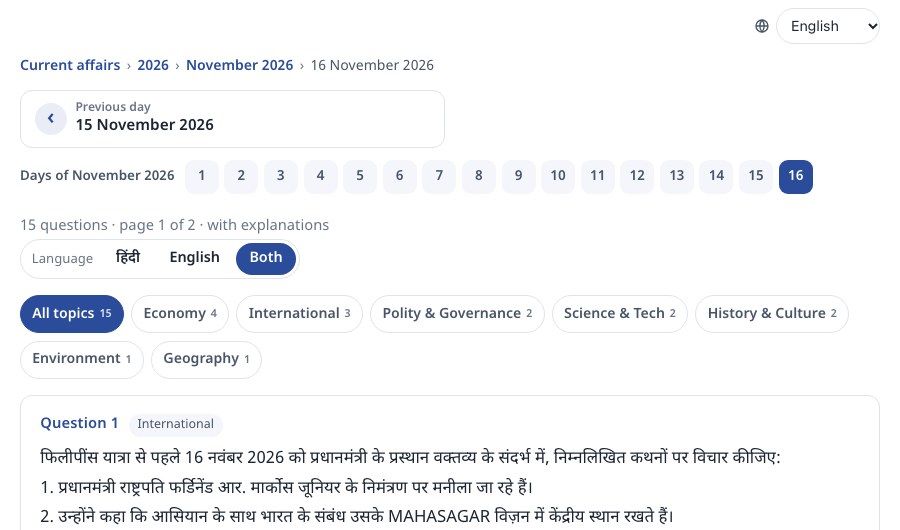
Prayag IAS Academy free daily current affairs quiz, with Hindi, English or both languages and topic filters. Screenshot of prayagiasacademy.com/practice/, 18 November 2026.
Current affairs is the part of the syllabus that changes every day, and it is the part most students fall behind on. That is why we publish a free practice set every morning. Each set has 15 questions on the previous day’s news, in Hindi, English or both side by side, with an explanation for every answer and topic filters for Polity, Economy, International Relations, Environment and more.
It is open to every aspirant in India. There is no login, no fee and no app download. You can also browse past days and months from the Current Affairs page, and see all our free practice sets on the Test Series page.
Use it like this: take the day’s set in under 15 minutes, note every question you got wrong or guessed, and look up that topic in a standard source. Over a month this builds a habit that most paid courses struggle to give you. Our guide on building a Prelims error log shows how to keep that record.
Can you clear UPSC with online preparation?
Yes, many do, but almost always with a plan they actually follow. The common pattern among students who clear the exam through online preparation is simple:
A fixed weekly timetable, written down, with more hours on weekends if they work.
One main source per subject, not five. Online students often collect too many courses and finish none.
Answer writing from the start, not after Prelims. Even 2 answers a day adds up to over 600 in a year.
Timed tests every week for Prelims, and full-length mocks from about three months before the exam.
Someone to check their work, whether a mentor, a peer group or a test series with evaluation.
For Judiciary (PCS-J or Civil Judge) exams the logic is the same, but three things are different:
The exam is state-specific. Each High Court or State Public Service Commission sets its own syllabus, including state laws and a local-language paper in many States. An online course built for one State may not cover another’s local laws.
Bare Acts come first. Good Judiciary preparation is built on reading the Acts themselves, plus leading judgments, not only on notes.
Judgment and essay writing need checking. As with UPSC Mains, ask how written work will be evaluated.
If you are preparing from outside Uttarakhand and want to know whether our app courses suit your exam, call us on +91 82796 90799 or use the form on this page. We will tell you honestly if a different option suits you better.
FAQs on online UPSC coaching in India
Is online coaching enough to clear UPSC?
It can be, if the course gives you a fixed schedule, regular tests and real evaluation of your answers, and if you follow a written timetable. Many candidates combine online lectures with a separate test series.
How much does online UPSC coaching cost in India?
In November 2026, full GS programmes ranged from about ₹50,000 for recorded courses to ₹60,000–₹90,000 for live online plans, and up to ₹1.55 lakh for some live online programmes. Test series alone cost from about ₹1,000 to ₹20,000.
Which is better for UPSC, live or recorded classes?
Live classes suit students who need a timetable and want to ask questions in class. Recorded classes are cheaper and flexible but need strong self-discipline. Many students choose a hybrid with live classes and recordings.
Can I prepare for UPSC online in Hindi medium?
Yes. Check that the tests, notes and answer evaluation are in Hindi, not only the lectures. Prayag IAS Academy’s free daily current affairs quiz is available in Hindi, English or both.
Do I need a test series for UPSC Prelims?
Most successful candidates practise with timed tests. Start with UPSC’s previous question papers, which are free on upsc.gov.in, then add a test series about three to four months before Prelims.
Is there free UPSC current affairs practice online?
Yes. Prayag IAS Academy publishes a free 15-question current affairs quiz every day on the previous day’s news, in Hindi and English, with explanations. No login is needed.
When is UPSC Prelims 2027?
UPSC’s calendar lists the Civil Services Preliminary Examination 2027 on 23 May 2027, with the notification on 13 January 2027. Dates can change, so check the notification.
Can working professionals prepare for UPSC online?
Yes. Recorded or hybrid courses let you study early mornings, evenings and weekends. Plan 3 to 4 hours on weekdays and more on weekends, and keep weekly tests fixed in your calendar.
Fee ranges are a general guide from public fee pages and may have changed; check the exact fee before paying. The Dholpur House photo is from Wikimedia Commons; the credit and licence are in its caption.
BIMSTEC was founded on 6 June 1997 and has seven members, a Secretariat in Dhaka and seven sectors. This week’s news, the Sixth Summit outcomes, a SAARC-ASEAN comparison and UPSC notes, with Hindi quick facts.
COP31 in Antalya ended on 22 November 2026 without adopting the Antalya Pact. Why it failed, what was agreed, what India said and the key terms for UPSC.
UPSC CSE 2026 interviews run from 7 December 2026 to 12 February 2027 for 2,526 candidates. How to find your date, reporting time, e-Summon, travel allowance and a plan for the weeks left.
The 1996 Ganga Water Treaty with Bangladesh expires on 12 December 2026. The Farakka sharing formula, what happens if it lapses, what each side wants, and how to prepare it for UPSC.