How to Build a Personal UPSC Prelims Error Log That Improves Every Mock Test
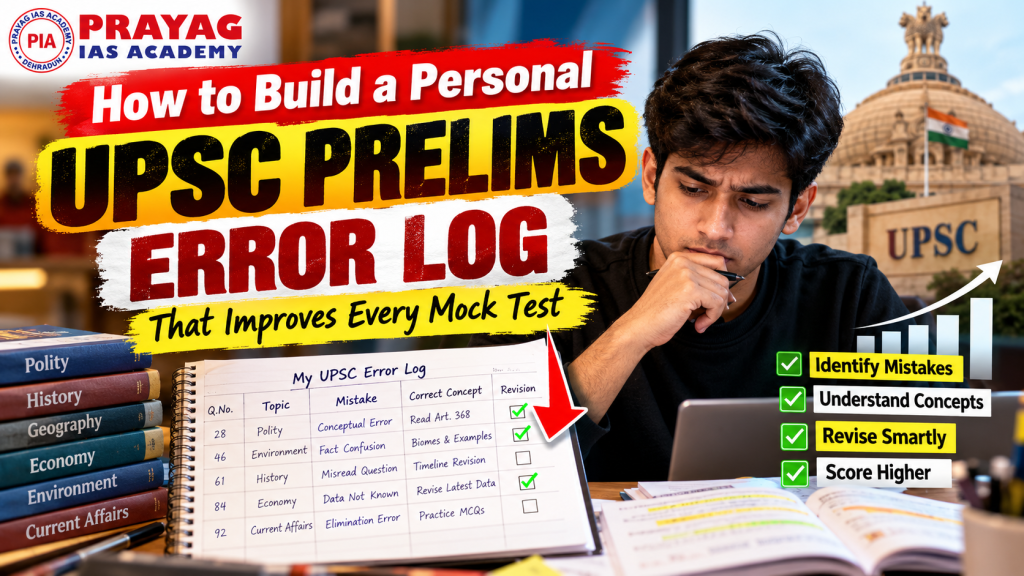
Success in the UPSC Civil Services Examination doesn’t happen by chance—it results from systematic preparation, continuous learning, and most importantly, learning from mistakes. Among the most effective strategies adopted by UPSC toppers is maintaining a UPSC Prelims error log that tracks every wrong answer and missed opportunity in mock tests.
If you’re struggling to improve your mock test scores or find yourself repeating the same mistakes, a UPSC Prelims error log could be the game-changer your preparation needs. This comprehensive guide explains how to build and maintain an error log that transforms your mock test performance.
Why Every UPSC Prelims Mock Test Needs a Personal Error Log
The UPSC Preliminary examination is unlike any other competitive exam you’ve encountered. With approximately 2.5 million aspirants competing for just 1000 positions, every single mark matters. Your mock test performance is a direct reflection of your preparation quality, and more importantly, your ability to learn from errors.
A UPSC Prelims error log serves as your personal diagnostic tool. While most aspirants simply move on after completing a mock test, toppers dig deeper. They understand that every wrong answer carries a lesson, and maintaining a systematic UPSC Prelims error log helps them:
- Identify pattern-based mistakes that repeat across multiple tests
- Pinpoint knowledge gaps in specific subjects or topics
- Differentiate between careless errors and conceptual misunderstandings
- Track progress objectively over weeks and months
- Create targeted revision plans based on actual performance data
Data Point
Studies show that aspirants who maintain a systematic UPSC Prelims error log improve their mock test scores by an average of 8-12% within 3 months of consistent tracking.
What Is a UPSC Prelims Error Log and How Does It Work?
A UPSC Prelims error log is a structured document where you record every wrong answer from your mock tests along with detailed analysis of why the mistake occurred. It’s not merely a list of incorrect questions; it’s a comprehensive database that transforms your preparation approach.
How Does a UPSC Prelims Error Log Function?
The mechanics of maintaining a UPSC Prelims error log are straightforward but require discipline:
1. Immediate Recording: After completing each mock test, record every wrong answer while details are fresh
2. Detailed Analysis: Document why you selected the wrong option and what the correct answer should be
3. Categorization: Classify each error into specific categories for pattern recognition
4. Regular Review: Schedule weekly reviews of your UPSC Prelims error log to track patterns
5. Targeted Revision: Use insights from the log to guide your daily revision schedule
When maintained consistently, a UPSC Prelims error log acts as a mirror to your preparation, revealing exactly where your efforts should be focused.
Choosing the Right Format: Notebook, Google Sheets, or Digital Tracker
The effectiveness of your UPSC Prelims error log depends partly on choosing the right medium. Different formats suit different preferences and preparation styles.
| Format | Advantages | Disadvantages | Best For |
|---|---|---|---|
| Physical Notebook | No distractions, better memory retention, personal touch | Difficult to search, cannot backup, time-consuming to organize | Those who prefer tactile learning and have limited internet access |
| Google Sheets | Sortable, searchable, cloud backup, easy sharing with mentors, free | Requires internet, less detailed analysis space, fewer formatting options | Most UPSC aspirants who want organized, accessible tracking |
| Digital Apps | Automated analysis, progress charts, notifications, mobile-friendly | Subscription costs, requires consistent app updates, can be overwhelming | Tech-savvy aspirants who want advanced analytics |
| Hybrid Approach | Quick notes in notebook, detailed entry in spreadsheet later | Requires duplicate effort, time management challenge | Serious aspirants with enough preparation time |
Recommendation: For most UPSC aspirants, Google Sheets combined with brief notebook entries strikes the perfect balance between ease of use and analytical power. At Prayag IAS Academy’s UPSC Foundation program, we recommend Google Sheets as the standard for maintaining a UPSC Prelims error log.
Essential Columns to Include in Your UPSC Mistake Log
The structure of your UPSC Prelims error log determines how effectively you can analyze and learn from mistakes. Here are the essential columns every aspirant should include:
Core Columns for Your UPSC Prelims Error Log
- Mock Test Number: Which test (Mock 1, Mock 2, etc.) to track chronological progress
- Question Number: Original question reference for future lookup
- Subject/Topic: Which GS subject (Polity, History, Geography, etc.) for subject-wise analysis
- Sub-topic: More specific classification within the subject
- Your Answer: What you selected during the test
- Correct Answer: The actual correct option
- Error Type: How you’ll classify this mistake (see Section 5)
- Reason for Mistake: Detailed explanation of why you got it wrong
- Correct Concept: The concept or fact you missed or misunderstood
- Revision Status: Track whether you’ve revisited this topic
- Date of Review: When you last studied the related concept
- Repetition Count: How many times this error pattern has occurred
A well-structured UPSC Prelims error log with these columns transforms raw mistake data into actionable intelligence for your preparation.
Impact of UPSC Reforms on Prelims Preparation
The prelims stage of UPSC Exam Reforms 2026 now incorporates more inference-based questions requiring aspirants to analyze passages, interpret data, and draw logical conclusions. Static knowledge alone is insufficient; candidates must develop the ability to reason through question stems and evaluate options critically.
The CSAT section has become increasingly logic-intensive, testing aptitude for systematic thinking rather than merely numerical skills. Current Affairs questions now often include analytical components asking “why” an event is significant rather than just “what” happened. This fundamental change requires aspirants to strengthen their engagement with daily current affairs through Prayag IAS Academy’s curated analysis.
How to Classify Errors: Knowledge Gaps, Misreading, Guesswork, and Concept Confusion
Not all wrong answers are created equal. A UPSC Prelims error log becomes truly powerful when you understand the root cause of each mistake. Classification is the key to this understanding.
Four Primary Error Categories in a UPSC Prelims Error Log
1. Knowledge Gap
- You lacked the fundamental knowledge required to answer
- Example: Not knowing the capital of a state or important dates
- UPSC Prelims error log action: Schedule focused study on this specific topic
2. Concept Confusion
- You had some knowledge but misunderstood the core concept
- Example: Confusing parliamentary vs. presidential system features
- UPSC Prelims error log action: Deep conceptual revision required
3. Misreading/Careless Error
- You knew the answer but misread the question or options
- Example: Missing a “NOT” in the question or overlooking a modifier
- UPSC Prelims error log action: Develop reading strategies to prevent repetition
4. Guesswork
- You had no idea and selected an answer randomly
- Example: Pure guess between two options
- UPSC Prelims error log action: Fill the knowledge gap immediately
When maintaining your UPSC Prelims error log, be brutally honest about error classification. This honesty is where transformation begins.
Step-by-Step Method to Record Mistakes After Every Mock Test
Timing and methodology matter immensely when maintaining a UPSC Prelims error log. Here’s the exact process expert mentors recommend:
Your 5-Step UPSC Prelims Error Log Process
Step 1: Immediate Post-Test Analysis (Day 1)
- Within 12 hours of completing the mock test, list all wrong answers
- Note your selected answer and the correct answer
- Record preliminary thoughts on why you got it wrong
- This quick entry ensures you capture the thought process while it’s fresh
Step 2: Subject-wise Solution Review (Day 1-2)
- Go through official solutions for each wrong answer
- Read detailed explanations provided by the test series
- Update your UPSC Prelims error log with accurate information
Step 3: Deep Concept Research (Day 2-3)
- Consult your study materials for questions requiring concept clarity
- Refer to NCERT textbooks or standard references
- Document the correct concept in your UPSC Prelims error log
Step 4: Error Classification (Day 3)
- Assign one of the four error types to each mistake
- Write detailed reason for the error in your UPSC Prelims error log
Step 5: Integration with Revision Schedule (Week 1)
- Use your UPSC Prelims error log to identify topics for focused revision
- Schedule specific revision sessions for weak areas
How to Analyse Correct Answers That Were Based on Guesswork
One unique aspect of maintaining a comprehensive UPSC Prelims error log is tracking correct answers you got through luck rather than knowledge. These “false positives” can hide genuine knowledge gaps.
Why Include Correct Guesses in Your UPSC Prelims Error Log
- False Confidence: You may overestimate your preparation level
- Hidden Gaps: You avoided learning something important by getting lucky
- Future Liability: You might get the same question type wrong if tested differently
How to Track Correct Guesses in Your UPSC Prelims Error Log
- Create a separate section in your UPSC Prelims error log for “Correct by Chance”
- Mark these questions with a special identifier (★ or ⚠️)
- Study the concept thoroughly as if you had answered incorrectly
- Revisit these questions specifically in weekly reviews
This practice transforms your UPSC Prelims error log from a mistake tracker into a comprehensive knowledge auditor.
Using Subject-Wise Error Tracking to Identify Weak Areas
The true power of a UPSC Prelims error log emerges when you analyze patterns across subjects and topics. This data-driven approach helps you allocate study time where it matters most.
Subject-Wise Analysis of Your UPSC Prelims Error Log
| GS Subject | Key Topics for Error Tracking | Common Error Types |
|---|---|---|
| Polity | Constitutional provisions, Acts, Powers/Rights | Concept confusion between similar institutions |
| History | Dates, Events, Personalities, Movements | Knowledge gaps, date-related misreading |
| Geography | Physical features, States, Climate zones, Resources | Guesswork on location-based questions |
| Economics | Concepts, Policies, Terminology, Mechanisms | Concept confusion, knowledge gaps |
| Science & Tech | Breakthroughs, Terminology, Concepts, Applications | Knowledge gaps due to rapid updates |
Creating Subject-Wise Statistics in Your UPSC Prelims Error Log
- Calculate error percentage for each subject: (Errors in Subject / Total Questions in Subject) × 100
- Identify your three weakest subjects
- Determine which subjects have most knowledge gaps vs. careless errors
- Track improvements month-over-month using your UPSC Prelims error log data
At Prayag IAS Academy, our expert faculty guides students in using their UPSC Prelims error log for subject-specific improvements that yield measurable results.
How to Convert Repeated Mistakes into a Targeted Revision Plan
The ultimate purpose of maintaining a UPSC Prelims error log is translating error data into action. Targeted revision based on your error patterns is where mock test improvement becomes reality.
Converting Your UPSC Prelims Error Log into a Revision Strategy
Step 1: Identify Recurring Error Patterns
- Review your UPSC Prelims error log to find questions repeated across mock tests
- Look for similar question types getting wrong consistently
- Note topics appearing multiple times in your error log
Step 2: Prioritize High-Impact Topics
- Topics appearing 3+ times in your UPSC Prelims error log = highest priority
- Topics with multiple error types = complex, needs multi-angle study
- Allocate study time proportional to your error frequency
Step 3: Design Specific Revision Sessions
- Schedule 2-3 hour focused revision blocks on high-error topics
- Use NCERT references and standard books as mentioned in your UPSC Prelims error log
- Create flashcards for frequently missed facts
Step 4: Practice Targeted Question Sets
- Solve additional questions on weak topics from other test series
- Track results separately in your UPSC Prelims error log
- Continue until your accuracy on these topics reaches 90%+
Weekly Error Log Review: Measuring Accuracy and Progress Across Mock Tests
A UPSC Prelims error log only works if you review it systematically. Weekly reviews ensure patterns don’t go unnoticed and progress remains visible.
Your Weekly UPSC Prelims Error Log Review Template
- Monday Reflection (1 hour): Review all errors from weekend mock tests
- Tuesday-Wednesday Deep Dive (2-3 hours): Research and complete solutions for wrong answers
- Thursday Analysis (1 hour): Create weekly statistics from your UPSC Prelims error log
- Friday Planning (30 minutes): Adjust next week’s revision plan based on error patterns
Key Metrics to Track in Your UPSC Prelims Error Log
- Total errors this week vs. last week
- Percentage improvement in accuracy
- Most common error type this week
- Subject showing most improvement
- Subject requiring urgent attention
💡 Pro Tip: Create a simple graph tracking your mock test scores and error count over time. Visualizing progress from your UPSC Prelims error log provides tremendous motivation during difficult preparation phases.
Common Mistakes to Avoid While Maintaining a UPSC Prelims Error Log
Even aspiring civil servants sometimes get the method wrong! Here are critical errors to avoid when maintaining your UPSC Prelims error log:
Top Mistakes in UPSC Prelims Error Log Maintenance
- ❌ Incomplete Recording: Skipping errors you’re unsure about. Every wrong answer—no matter how silly—belongs in your UPSC Prelims error log
- ❌ Vague Error Classification: Using unclear categories. Stick to the four types: Knowledge Gap, Concept Confusion, Misreading, Guesswork
- ❌ Delayed Documentation: Waiting weeks to update your UPSC Prelims error log. Record while memory is fresh
- ❌ No Regular Review: Creating the log but never analyzing it. Weekly reviews are non-negotiable
- ❌ Ignoring Correct Guesses: Only tracking wrong answers in your UPSC Prelims error log. Document lucky correct answers too
- ❌ Analysis Paralysis: Over-complicating the log with too many columns. Stick to essentials for your UPSC Prelims error log
- ❌ Not Acting on Data: Maintaining perfect UPSC Prelims error log records but not using them to guide revision
Conclusion: Build a Smarter Mock Test Strategy Through Consistent Error Analysis
Consistent error analysis is essential for improving UPSC Prelims performance and making every mock test more productive. By maintaining a personal error log, identifying recurring mistakes, revising weak topics, and understanding why incorrect answers occur, aspirants can gradually strengthen their conceptual clarity and accuracy. Reviewing both incorrect answers and lucky guesses helps uncover knowledge gaps that might otherwise go unnoticed. Instead of focusing only on mock test scores, candidates should track their progress, refine their revision strategies, and practise applying concepts under exam conditions.
FAQs: UPSC Prelims Error Log
1. How to create a UPSC Prelims error log for better preparation?
To create a UPSC Prelims error log, record mistakes from mock tests, identify weak topics, note the correct explanations, and revise recurring errors regularly to improve accuracy.
2. How can UPSC Prelims mock test analysis improve exam performance?
UPSC Prelims mock test analysis helps aspirants identify knowledge gaps, improve time management, reduce repeated mistakes, and develop effective question-solving strategies.
3. What is the best way to analyze UPSC Prelims mock tests?
The best approach is to review incorrect answers, guessed answers, and time-consuming questions, understand the reasons behind each mistake, and plan targeted revision.
4. How to improve UPSC Prelims accuracy through error analysis?
Aspirants can improve accuracy by tracking conceptual errors, practising elimination techniques, revising important facts, and reviewing their personal error log after every mock test.
5. Which topics should be included in a UPSC Prelims mistake notebook?
Include errors related to Polity, History, Geography, Economy, Environment, Science and Technology, and Current Affairs, along with the reason for each mistake and its correct explanation.
Request Free Counseling
Speak with our expert mentors today.
How to Build a Personal UPSC Prelims Error Log That Improves Every Mock Test
How to Build a Personal UPSC Prelims Error Log That Improves Every Mock Test Success in the UPSC Civil Services Examination doesn’t happen by chance—it

Uttarakhand’s New Irrigation Bill 2026: Key Changes and UKPCS Relevance
Uttarakhand’s New Irrigation Bill 2026: Key Changes and UKPCS Relevance The Uttarakhand’s New Irrigation Bill 2026 marks a watershed moment in the state’s water governance

UPSC Exam Reforms 2026: Why Reasoning and Decision-Making Matter More
UPSC Exam Reforms 2026: Why Reasoning and Decision-Making Matter More The UPSC Exam Reforms 2026 introduce a paradigm shift from conventional knowledge-based assessment to capability-based

26th SCO Summit 2026: Why It Matters for India
26th SCO Summit 2026: Why It Matters for India The 26th SCO Summit 2026 marks a significant milestone in the Shanghai Cooperation Organisation’s evolution. Held