
Blog

26th SCO Summit 2026: Why It Matters for India
26th SCO Summit 2026: Why It Matters for India The 26th SCO Summit 2026 marks a significant milestone in the Shanghai Cooperation Organisation’s evolution. Held
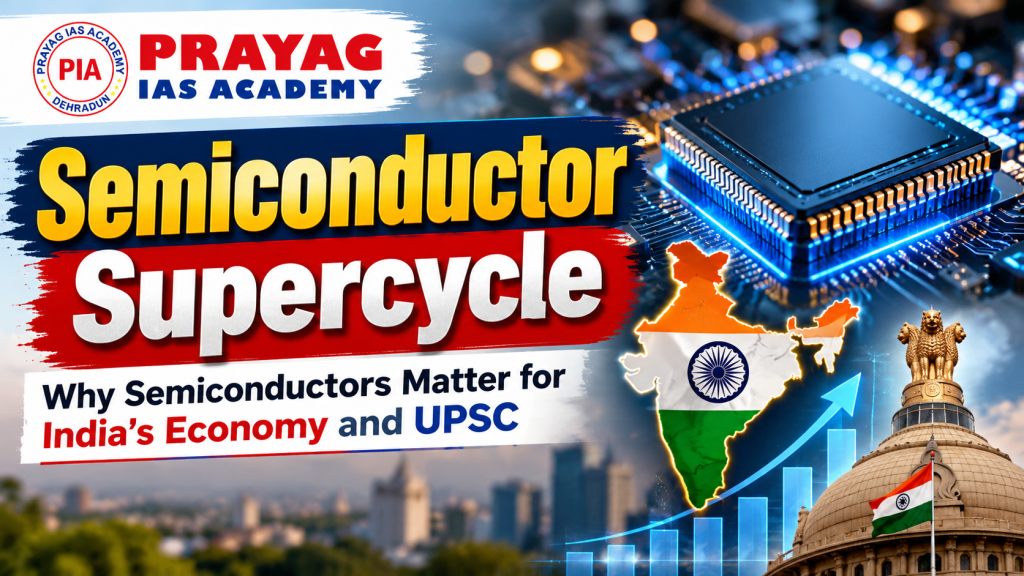
A semiconductor supercycle is an extended period of elevated demand for semiconductor chips driven by technological innovation and transformative industry shifts. Unlike regular business cycles, a semiconductor supercycle can last 5-10 years, characterized by sustained high demand, supply constraints, and premium pricing.
The current semiconductor supercycle is powered by multiple converging trends: artificial intelligence boom, data center expansion, electric vehicle revolution, and 5G infrastructure deployment. For UPSC aspirants studying at Prayag IAS Academy’s UPSC Foundation program, understanding this phenomenon is crucial for both Prelims and Mains examinations.
Key characteristics of the semiconductor supercycle:
Semiconductors are the backbone of modern civilization, influencing sectors worth trillions of dollars globally. The global semiconductor market reached $574 billion in 2023 and is projected to exceed $1 trillion by 2030.
Economic Impact Table:
| Metric | 2023 Value | 2030 Projection | CAGR |
|---|---|---|---|
| Global Semiconductor Market | $574 Billion | $1.1 Trillion | 8.5% |
| Semiconductor Equipment Market | $92 Billion | $150 Billion | 6.5% |
| Chip Design Services | $45 Billion | $85 Billion | 8.2% |
| Manufacturing Capacity (nm tech) | 5nm leading edge | 2nm leading edge | N/A |
The semiconductor industry employs over 3 million people globally and contributes significantly to trade balances. For countries like the United States, semiconductors remain a strategic asset, while China invests heavily to achieve self-sufficiency. India’s role in this semiconductor supercycle is emerging as a game-changer.
India’s semiconductor sector, though nascent compared to Taiwan and South Korea, is poised for exponential growth. Currently, India manufactures less than 2% of global semiconductor production but aims to capture 10% by 2032.
The Indian semiconductor industry presents unique opportunities:
For UPSC Daily Current Affairs preparation, India’s semiconductor ambitions feature prominently in discussions around industrial policy, Make in India, and strategic autonomy.
Launched in December 2021, the India Semiconductor Mission is a transformative initiative aimed at establishing a complete semiconductor ecosystem in India. This mission encompasses semiconductor manufacturing, design, and packaging.
Key objectives of the India Semiconductor Mission:
Budget allocation: ₹76,000 crore ($9.9 billion) over 5 years demonstrates India’s commitment to this semiconductor supercycle opportunity. This scheme includes:
India’s semiconductor manufacturing initiatives focus on establishing world-class Fabs. Two major projects are underway:
1. Vedanta-Foxconn Partnership (Gujarat)
2. ISMC (Singapore-backed) Project (Karnataka)
These initiatives position India strategically within the global semiconductor supercycle, offering alternative sourcing to Western nations concerned about over-reliance on Taiwan and China. The manufacturing sector will drive India’s GDP growth and technological sovereignty.
India possesses significant strength in semiconductor design services, where it already holds 15-20% of the global market. Companies like Flipkart, HCL Technologies, and numerous startups engage in chip design for global clients.
India’s strength in semiconductor design:
Chip packaging and testing, historically outsourced to countries like Malaysia and Thailand, present another opportunity. India is establishing advanced packaging facilities to integrate semiconductor chips for applications requiring miniaturization.
The semiconductor supercycle is fundamentally driven by artificial intelligence and data center expansion. High-performance chips like GPUs (Graphics Processing Units) and TPUs (Tensor Processing Units) form the foundation of AI infrastructure.
AI-driven semiconductor demand factors:
For UPSC Mains answer writing, students should understand how semiconductor advancement enables India’s AI capabilities, making it relevant to topics like digital transformation and technological sovereignty.
Electric vehicles (EVs) and renewable energy systems are massive consumers of semiconductors within this semiconductor supercycle. Each EV contains 3,000+ semiconductor chips, compared to 1,400 in traditional vehicles.
Semiconductor consumption in energy transition:
| Application | Chips per Unit | Annual Growth |
|---|---|---|
| Electric Vehicles | 3,000-4,500 | 35% CAGR |
| Solar Inverters | 150-300 | 25% CAGR |
| Wind Turbines | 500-1,000 | 20% CAGR |
| Battery Management Systems | 200-400 | 40% CAGR |
India’s ambitious target of 5 million EVs by 2030 and 500 GW renewable capacity will substantially increase semiconductor demand. This creates interconnection topics for UPSC: climate change, sustainable development, and technological infrastructure.
Semiconductors hold paramount importance for national defence and security. Advanced weaponry, missiles, radar systems, and cybersecurity infrastructure depend on cutting-edge chips.
Defence semiconductor applications:
India’s semiconductor self-sufficiency directly correlates with strategic autonomy. The current semiconductor supercycle provides India an unprecedented opportunity to reduce dependency on external chip sources for defence applications. This aspect connects to UPSC Mains topics: national security, defence preparedness, and self-reliance (Atmanirbhar Bharat).
The semiconductor supercycle presents transformative economic opportunities for India:
Direct economic benefits:
Indirect economic multipliers:
India’s semiconductor industry could contribute 2-3% to GDP growth by 2032, making this sector comparable to information technology in economic significance.
Building a robust semiconductor supply chain requires ecosystem development across multiple layers:
Raw materials layer:
Equipment and materials layer:
Design and development layer:
Manufacturing and testing layer:
Developing this complete semiconductor supercycle supply chain requires coordination between government, private enterprises, and research institutions—a topic increasingly featured in UPSC examinations around India’s industrial policy and sectoral development.
Despite promising opportunities, India faces significant obstacles in capturing this semiconductor supercycle:
Technical Challenges:
Investment Challenges:
Infrastructure Challenges:
For UPSC Mains preparation, these challenges are important to discuss critically in essays and answer writing, demonstrating nuanced understanding of industrial development complexities.
The Indian government has implemented comprehensive support mechanisms for the semiconductor industry:
Production Linked Incentive (PLI) Scheme:
Semicon India Program:
SEMI-CON Policy 2021:
These initiatives position India competitively within the global semiconductor supercycle, attracting multinational manufacturers seeking geographic diversification.
Semiconductors are increasingly appearing in UPSC examinations across both Prelims and Mains:
UPSC Prelims Focus Areas:
UPSC Mains Answer Writing Topics:
Sample UPSC Question Pattern: “India’s semiconductor industry is critical for achieving technological sovereignty. Discuss the significance of the semiconductor supercycle for India’s economy and outline government initiatives aimed at establishing indigenous semiconductor manufacturing capacity.”
For comprehensive UPSC guidance, students should combine current affairs updates with conceptual clarity on how semiconductors integrate with broader themes of national security, economic development, and technological innovation.
The semiconductor supercycle represents a transformational opportunity for India to establish itself as a global technology powerhouse. By leveraging government initiatives, attracting foreign investment, and developing human capital, India can capture substantial value in this $1+ trillion industry.
Key takeaways for UPSC aspirants:
For UPSC preparation at Prayag IAS Academy, mastering semiconductor topics requires understanding both technical fundamentals and policy frameworks. Students should follow daily current affairs updates on semiconductor developments and practice structured answer writing incorporating this knowledge.
The semiconductor supercycle presents India an unprecedented chance to rewrite its technological narrative—a narrative that UPSC aspirants must comprehend to excel in civil service examinations and contribute meaningfully to the nation’s development.
The semiconductor supercycle is a prolonged period of strong chip demand driven by AI, electric vehicles, data centres, smartphones, defence and advanced electronics. For India, it creates opportunities for manufacturing, investment, exports, skilled jobs and stronger technology supply chains.
Semiconductors are a critical foundation of India’s digital economy and manufacturing sector. A stronger domestic semiconductor industry can reduce supply-chain dependence, attract investment, support electronics manufacturing and contribute to long-term economic growth.
India Semiconductor Mission is the government’s initiative to develop a sustainable semiconductor and display manufacturing ecosystem in India. It supports semiconductor fabrication, packaging, design and related capabilities.
Semiconductors are an important UPSC topic because they connect Science and Technology with the Indian economy, national security, industrial policy, digital infrastructure and international supply chains. Questions can be relevant to both UPSC Prelims and Mains.
India faces challenges including high investment requirements, advanced technology needs, skilled workforce shortages, infrastructure requirements, water and energy consumption, and dependence on global semiconductor supply chains.
Speak with our expert mentors today.
26th SCO Summit 2026: Why It Matters for India The 26th SCO Summit 2026 marks a significant milestone in the Shanghai Cooperation Organisation’s evolution. Held
Semiconductor Supercycle: Why Semiconductors Matter for India’s Economy and UPSC What Is a Semiconductor Supercycle? A semiconductor supercycle is an extended period of elevated demand

BRICS 2026: India’s Role, Expansion and Global Significance The BRICS 2026 summit represents a pivotal moment in international relations, positioning BRICS 2026 as a cornerstone

To succeed in the UPSC exam, aspiring candidates must have the right combination of self motivation and management, practice, and good academic planning. Some candidates