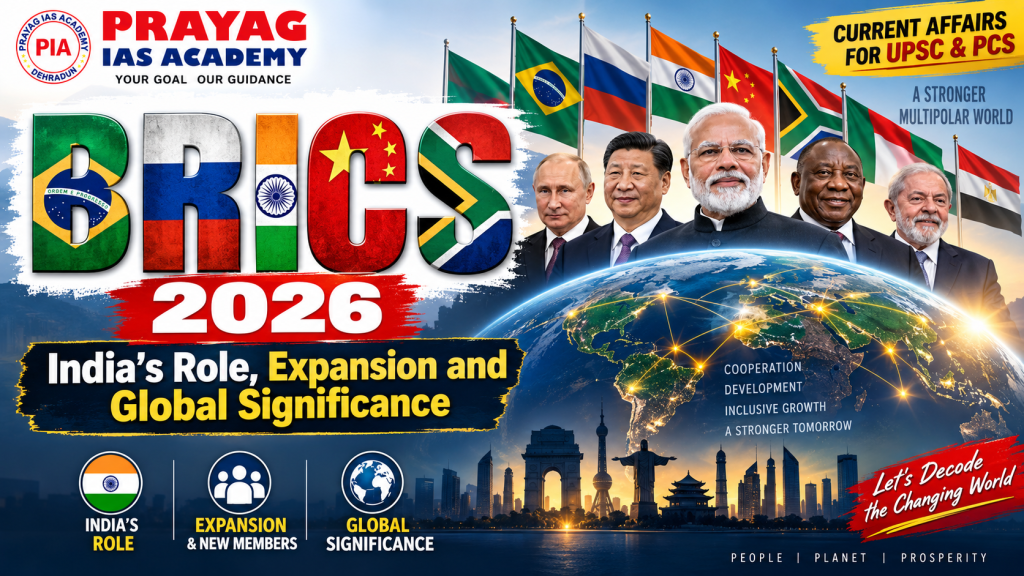
BRICS 2026: India’s Role, Expansion and Global Significance
The BRICS 2026 summit represents a pivotal moment in international relations, positioning BRICS 2026 as a cornerstone of India’s diplomatic and economic agenda. As the global order undergoes transformation, understanding BRICS 2026 becomes essential for UPSC aspirants and policymakers alike. India’s leadership during BRICS 2026 will showcase the nation’s commitment to redefining global governance structures and advancing the interests of developing nations. This comprehensive guide explores every facet of BRICS 2026: India’s role, the organization’s expansion, and its profound implications for global significance.
BRICS 2026: An Overview
What is BRICS?
BRICS 2026 represents an evolution of the BRICS bloc—originally comprising Brazil, Russia, India, China, and South Africa. This informal multilateral organization emerged in the early 2000s, gaining institutional momentum when the first BRICS summit occurred in 2009. BRICS 2026 signifies the organization’s maturation as a counterbalance to Western-dominated global institutions.
BRICS 2026 operates on principles of equality, mutual respect, and non-interference in internal affairs. The organization addresses contemporary global challenges including climate change, economic development, and security issues. For UPSC aspirants preparing for international relations topics, BRICS 2026 represents critical current affairs knowledge essential for both Prelims and Mains examinations.
Historical Context of BRICS Development
Understanding BRICS 2026 requires examining its evolutionary journey. BRICS emerged as a concept during the 2008 financial crisis, gaining relevance as emerging economies sought greater voice in global affairs. By 2026, BRICS 2026 has transformed from a concept into a substantive force reshaping international order, with India playing an increasingly central role.
BRICS 2026 Members and Recent Expansion
Original Members and New Entrants
BRICS 2026 experienced significant expansion, welcoming Egypt, Ethiopia, Iran, Saudi Arabia, and the UAE as full members. This enlargement of BRICS 2026 marks the first major expansion since the organization’s inception, transforming BRICS 2026 into a truly global coalition spanning Africa, Asia, and the Middle East.
The expansion of BRICS 2026 carries profound implications:
- Geographic Reach: BRICS 2026 now encompasses populations representing over 3.5 billion people
- Economic Integration: Combined GDP of BRICS 2026 member nations approaches $30 trillion
- Political Influence: BRICS 2026 commands significant voting power in international forums
Why Has BRICS Expanded?
Strategic Rationale Behind BRICS 2026 Expansion
The expansion reflected demands from multiple nations seeking alternatives to Western-centric institutions. BRICS 2026 expansion addresses:
- Developing Nations’ Aspirations: Countries seeking representation in global decision-making structures
- Economic Complementarities: New BRICS 2026 members bring crucial resources—oil, minerals, and manufacturing capacity
- Geopolitical Realignment: BRICS 2026 expansion counters Western dominance in international governance
- South-South Cooperation: BRICS 2026 strengthens cooperation among Global South nations
India's Role in BRICS 2026
India as a Leading Voice
India’s role in BRICS 2026 is transformative. As the world’s most populous democracy and a leading emerging economy, India shapes BRICS 2026’s agenda while advocating for the Global South’s interests. India’s position in BRICS 2026 enables Delhi to advance developmental priorities while addressing security concerns.
India’s Diplomatic Leadership in BRICS 2026
BRICS 2026 activities demonstrate India’s commitment to multilateralism. India’s role in BRICS 2026 includes:
- Chairing summit sessions and working groups
- Proposing frameworks for South-South cooperation through BRICS 2026
- Leveraging BRICS 2026 to strengthen ties with African and Middle Eastern nations
- Advancing India’s strategic interests through BRICS 2026 mechanisms
India's Key Priorities in BRICS 2026
Economic Development Through BRICS 2026
India prioritizes infrastructure development through the New Development Bank, established by BRICS 2026 members. India’s focus in BRICS 2026 includes financing sustainable development projects across member nations, particularly supporting renewable energy and transportation infrastructure.
Climate Action via BRICS 2026
India’s role in BRICS 2026 emphasizes climate resilience for developing economies. Through BRICS 2026, India advocates for differentiated responsibilities in climate action, ensuring developed nations bear greater mitigation burdens while supporting developing countries’ growth.
Digital Innovation in BRICS 2026
BRICS 2026 facilitates India’s digital revolution expansion. India’s tech expertise shapes BRICS 2026’s digital cooperation frameworks, positioning India as a leader in BRICS 2026’s emerging technologies initiatives.
Global South Representation Through BRICS 2026
India’s leadership in BRICS 2026 ensures the Global South’s voice in international monetary systems, global governance reforms, and development finance—critical for UPSC Mains essay topics.
BRICS and India's Foreign Policy
Alignment with India’s Strategic Autonomy
BRICS 2026 complements India’s foreign policy doctrine of strategic autonomy. India views BRICS 2026 as essential for maintaining independent policy direction while building multipolar alternatives. BRICS 2026 enables India to engage major powers—particularly China and Russia—within structured frameworks.
Balancing Regional and Global Interests
India’s BRICS 2026 participation balances:
- Asian regional concerns (through China engagement)
- African partnership development
- Middle Eastern energy security
- Western relationship management
BRICS and the Global Economy
Economic Cooperation Framework in BRICS 2026
BRICS 2026 promotes intra-member trade, with ambitious targets for increased commerce. India-Brazil bilateral trade through BRICS 2026 mechanisms has expanded significantly, while India’s engagement with African BRICS 2026 members strengthens supply chain resilience.
De-Dollarization Efforts by BRICS 2026
One of BRICS 2026’s most significant initiatives involves promoting alternative payment systems and local currency usage. BRICS 2026 members collaboratively explore alternatives to dollar-dominated systems, benefiting India’s foreign trade strategy and reducing forex vulnerabilities.
Trade Facilitation Through BRICS 2026
BRICS 2026 initiatives reduce trade barriers through:
- Harmonized customs procedures
- Mutual recognition of standards
- Joint logistics networks
- Digital trade platforms
New Development Bank and Its Importance
NDB’s Role in BRICS 2026 Evolution
The New Development Bank (NDB), established by BRICS 2026 members, finances infrastructure projects traditionally dependent on Western institutions. For UPSC candidates, understanding NDB’s importance in BRICS 2026 strategy demonstrates India’s institutional capacity building.
NDB’s Development Impact
NDB has committed substantial financing to India’s infrastructure—railways, smart cities, renewable energy projects. NDB’s operations embody BRICS 2026’s development philosophy prioritizing sustainability and member-state autonomy.
Expanding NDB Operations in BRICS 2026
With new BRICS 2026 members joining, NDB has expanded operations to Egypt, Iran, and other nations, demonstrating BRICS 2026’s institutional evolution beyond informal cooperation toward substantial development finance mechanisms.
Opportunities for India from BRICS Expansion
Market Access and Trade Benefits
BRICS 2026 expansion opens markets for Indian exports—textiles, pharmaceuticals, IT services, and agricultural products. India can leverage BRICS 2026 member relationships, particularly African nations, for market diversification reducing export concentration risks.
Investment Opportunities Through BRICS 2026
Indian enterprises gain unprecedented investment opportunities in BRICS 2026 members:
- Energy sector investments in Gulf states (BRICS 2026)
- Manufacturing hubs in African nations
- Technology partnerships across BRICS 2026 members
- Real estate and infrastructure development
Supply Chain Resilience via BRICS 2026
Following global supply chain disruptions, BRICS 2026 offers India diversification opportunities. India can source critical minerals from African BRICS 2026 members while exporting manufactured goods, strengthening self-reliance through BRICS 2026 cooperation.
Technology Transfer Through BRICS 2026
India’s IT expertise enables technology partnerships within BRICS 2026. India positions itself as BRICS 2026’s technology provider, particularly in emerging sectors like AI, renewable energy technology, and digital infrastructure.
Major Challenges Facing BRICS 2026
| Challenge | Impact on BRICS 2026 | India’s Approach |
|---|
| India-China Border Tensions | Strains BRICS 2026 consensus-building | Compartmentalization; bilateral discussions outside BRICS 2026 forums |
| Economic Disparities | Uneven BRICS 2026 benefit distribution | Proposing equitable development financing mechanisms |
| Geopolitical Divergences | Different foreign policy positions within BRICS 2026 | Emphasizing common Ground South interests over great power competition |
| Institutional Inefficiencies | Slow BRICS 2026 decision-making processes | Advocating institutional reforms within BRICS 2026 |
| Western Pressure | Sanctions affecting BRICS 2026 members | Building resilient BRICS 2026 structures immune to external pressure |
Navigating Intra-BRICS 2026 Tensions
India’s diplomatic skill lies in maintaining BRICS 2026 cohesion despite member-state differences. The India-China dynamic, while challenging, hasn’t derailed BRICS 2026 cooperation, demonstrating compartmentalization success—critical knowledge for UPSC Mains answers.
BRICS vs G7: Key Differences
Comparative Analysis: BRICS 2026 and Western Alternatives
| Aspect |
BRICS 2026 |
G7 |
| Membership |
11 members, representing Global South |
7 Western economies, representing developed nations |
| Combined GDP |
~$30 trillion |
~$40 trillion |
| Population |
3.5+ billion |
~800 million |
| Governing Philosophy |
Consensus-based, non-interference |
Liberal democracy, Western values |
| Development Focus |
Global South priorities, infrastructure |
Advanced economy interests |
| Decision-Making |
Participatory, often slow |
Efficient, Western-centric |
| Financial Institutions |
NDB (alternative to World Bank/IMF) |
IMF, World Bank, SWIFT dominated |
Why BRICS 2026 Matters Differently
BRICS 2026 represents multipolar alternatives, whereas G7 reflects unipolar/bipolar structures. For India, BRICS 2026 offers influence magnitude impossible within G7, making BRICS 2026 strategically invaluable.
BRICS and the Global South
BRICS 2026 as Global South Champion
BRICS 2026 articulates Global South aspirations toward equitable development, climate justice, and institutional reform. India’s BRICS 2026 engagement amplifies Global South voices—essential context for UPSC international relations answers.
BRICS 2026 Development Agenda
Through BRICS 2026, developing nations pursue:
- Technology transfer frameworks
- Favorable climate finance terms
- Debt relief mechanisms
- Democratic international governance
BRICS 2026: Important Facts for UPSC Prelims
Key Facts for Examination Preparation
- BRICS 2026 includes Brazil, Russia, India, China, South Africa, Egypt, Ethiopia, Iran, Saudi Arabia, UAE
- First BRICS summit convened in 2009
- New Development Bank established 2015
- India currently leads BRICS 2026 coordination efforts
- BRICS 2026 emphasizes non-interference and consensus-based decision-making
- BRICS 2026 represents approximately 3.5 billion population
- Combined BRICS 2026 GDP approaches $30 trillion
- BRICS 2026 advocates de-dollarization and alternative payment systems
- South Africa hosts BRICS 2026 Secretariat
- BRICS 2026 expansion reflects demand for multipolar world order
BRICS 2026: Mains Perspective for UPSC Aspirants
Essay Topics
“BRICS 2026: Reshaping Global Order” – Analyze BRICS 2026’s potential to reform international governance structures
“India’s Role in BRICS 2026: Opportunities and Challenges” – Discuss India’s leadership in BRICS 2026 and strategic implications
Answer Writing Framework
Strong UPSC Mains answers on BRICS 2026 should include:
- Context: Historical emergence of BRICS 2026
- India’s Specific Role: Diplomatic, economic, strategic contributions
- Policy Implications: BRICS 2026 impact on India’s foreign policy
- Global Significance: BRICS 2026 role in multipolar world
- Challenges: Internal contradictions and external pressures
- Future Outlook: BRICS 2026 trajectory and India’s position
Current Affairs Integration
For UPSC daily current affairs preparation, track BRICS 2026 developments including:
- Summit declarations and initiatives
- New member economic performances
- Institutional reforms within BRICS 2026
- India’s bilateral relations with member states
Conclusion
BRICS 2026 represents a transformative moment in global affairs, with India positioned at this reformation’s center. BRICS 2026’s significance extends beyond economic cooperation—it symbolizes multipolar world emergence challenging Western hegemony. India’s role in BRICS 2026 advances national interests—economic growth, development financing, climate action, and strategic autonomy—while contributing to global South empowerment.
For UPSC aspirants engaging with international relations topics, understanding BRICS 2026 comprehensively—its formation, expansion, India’s leadership, challenges, and global implications—proves essential for examination success. BRICS 2026 will feature prominently in Prelims MCQs, Mains essays, and interview discussions, making this knowledge investment valuable.
For comprehensive UPSC preparation on current affairs and international relations topics like BRICS 2026, connect with Prayag IAS Academy’s expert faculty who provide personalized guidance combining current affairs knowledge with answer-writing excellence.
Frequently Asked Questions About BRICS 2026