BIMSTEC Explained for UPSC: When It Was Founded, Members, Secretariat, Seven Sectors and This Week’s News
Short answer: BIMSTEC, the Bay of Bengal Initiative for Multi-Sectoral Technical and Economic Cooperation, was founded on 6 June 1997 by the Bangkok Declaration. It has seven members: Bangladesh, Bhutan, India, Myanmar, Nepal, Sri Lanka and Thailand. Its permanent Secretariat is in Dhaka, Bangladesh, opened in 2014, and its Charter was signed in Colombo on 30 March 2022. Bangladesh holds the chair since the Sixth Summit in Bangkok on 4 April 2025.
हिंदी में मुख्य तथ्य
बिम्सटेक की स्थापना कब हुई? 6 जून 1997, बैंकॉक घोषणा से (पहले नाम BIST-EC था)।
बिम्सटेक का सचिवालय कहाँ है? ढाका, बांग्लादेश (2014 से)।
सदस्य देश: बांग्लादेश, भूटान, भारत, म्यांमार, नेपाल, श्रीलंका और थाईलैंड (कुल 7)।
चार्टर: 30 मार्च 2022, पाँचवाँ शिखर सम्मेलन, कोलंबो।
By Prayag IAS Academy, Dehradun · Updated 24 November 2026 · Facts checked against bimstec.org and the Sixth Summit Declaration
Key takeaways
This week BIMSTEC finalised draft guidelines for a coordinated marine oil spill response in the Bay of Bengal (New Delhi, 17 November).
Secretary General Indra Mani Pandey of India completes his three-year term on 3 January 2027 and is making farewell visits.
Since 2022 BIMSTEC works in seven sectors, down from fourteen, under its first Charter.
The Sixth Summit adopted the Bangkok Vision 2030 and welcomed an Agreement on Maritime Transport Cooperation.
Exam angle: founding date, members, Secretariat, Charter, sectors and how it differs from SAARC and ASEAN.
What is BIMSTEC, and why is it in the news this week?
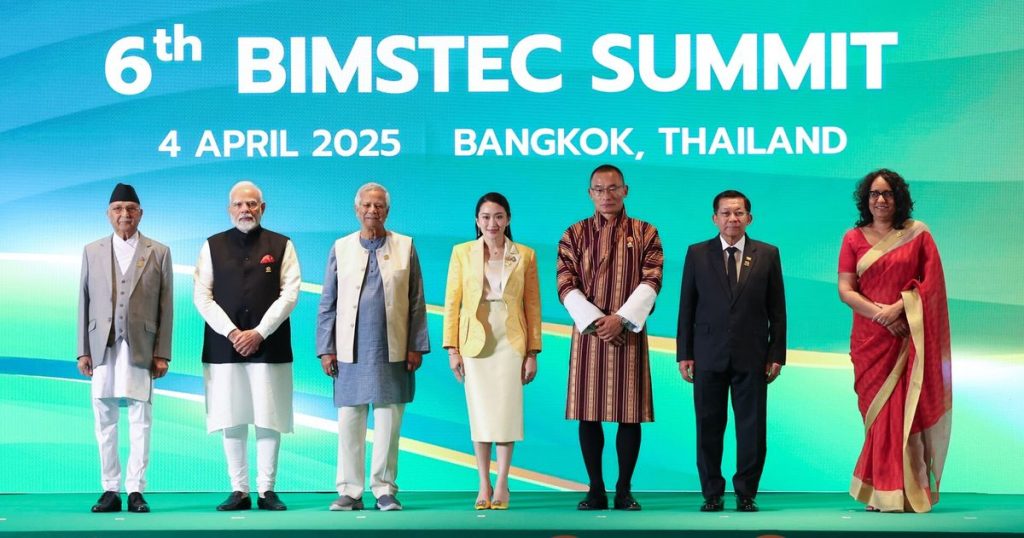
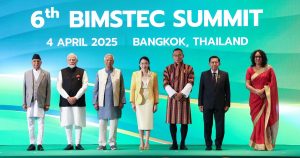
Leaders of the seven BIMSTEC member states at the Sixth BIMSTEC Summit in Bangkok on 4 April 2025. Photo: Prime Minister’s Office, Government of India (GODL-India), via Wikimedia Commons.
BIMSTEC rarely makes front-page news, but it keeps turning up in Prelims and in Mains questions on India’s neighbourhood. This week gave three fresh reasons to revise it, all reported by the BIMSTEC Secretariat itself:
Date
What happened
Source
11 November 2026
First BIMSTEC Health Ministers’ Meeting held in Colombo, Sri Lanka
5th meeting of the Expert Group on Maritime Security Cooperation in New Delhi finalised draft BIMSTEC Guidelines for Coordinated Marine Oil Spill Response in the Bay of Bengal, and examined regional search and rescue, maritime research and surveillance
None of these is a headline event on its own. Together they show a grouping that is quietly building practical cooperation at sea, in health and in tourism, which is exactly how UPSC tends to frame it.
When was BIMSTEC founded, and how did it grow?
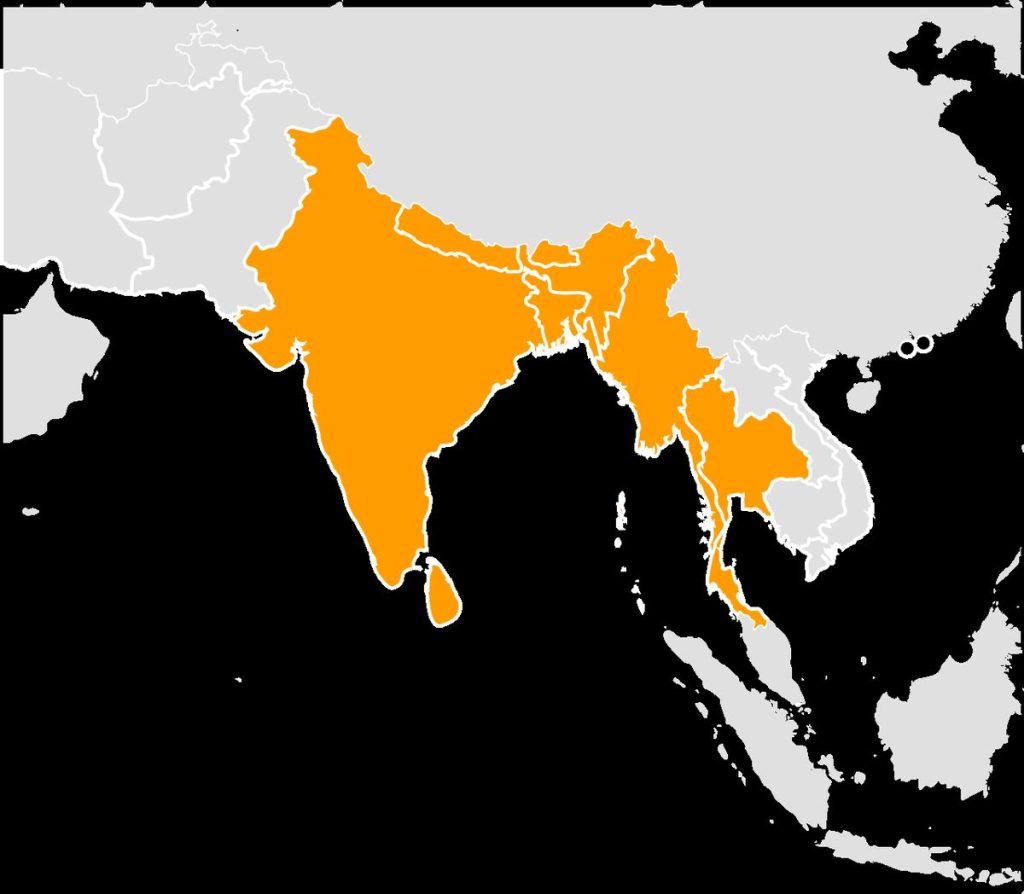
Map of the seven BIMSTEC member states: Bangladesh, Bhutan, India, Myanmar, Nepal, Sri Lanka and Thailand. Map: public domain, via Wikimedia Commons.
BIMSTEC began on 6 June 1997, when Bangladesh, India, Sri Lanka and Thailand signed the Bangkok Declaration. Here is how it grew, according to the BIMSTEC history page:
Date
Milestone
6 June 1997
Bangkok Declaration creates BIST-EC (Bangladesh, India, Sri Lanka, Thailand Economic Cooperation)
22 December 1997
Myanmar joins; the group becomes BIMST-EC
2004
Nepal and Bhutan admitted
31 July 2004
First Summit, Bangkok: renamed the Bay of Bengal Initiative for Multi-Sectoral Technical and Economic Cooperation
13 November 2008
Second Summit, New Delhi
4 March 2014
Third Summit, Nay Pyi Taw: agreement to set up a permanent Secretariat
13 September 2014
Secretariat inaugurated in Dhaka
16 October 2016
Leaders’ Retreat in Goa, India
30–31 August 2018
Fourth Summit, Kathmandu
30 March 2022
Fifth Summit, Colombo (virtual): Charter signed; sectors cut to seven
Note the shape of the group: five South Asian countries and two from Southeast Asia, all linked by the Bay of Bengal or its river basins. Nepal and Bhutan are landlocked but depend on the Bay for trade.
Where is the BIMSTEC Secretariat, and who heads it?
The BIMSTEC Secretariat is in Dhaka, Bangladesh. Leaders agreed to create it at the Third Summit in March 2014, and it opened on 13 September 2014.
It is headed by a Secretary General. Under the Charter, the Secretary General:
is appointed by the BIMSTEC Ministerial Meeting on the recommendation of the Senior Officials’ Meeting;
serves a non-renewable term of three years;
is nominated by member states in alphabetical rotation, and holds ambassadorial rank.
The current Secretary General is Indra Mani Pandey of India, the fourth to hold the post, in office since 4 January 2024. The Secretariat says his tenure ends on 3 January 2027, so a new Secretary General will be chosen in the coming weeks. That appointment is a likely current affairs question for 2027.
What are BIMSTEC's seven sectors of cooperation?
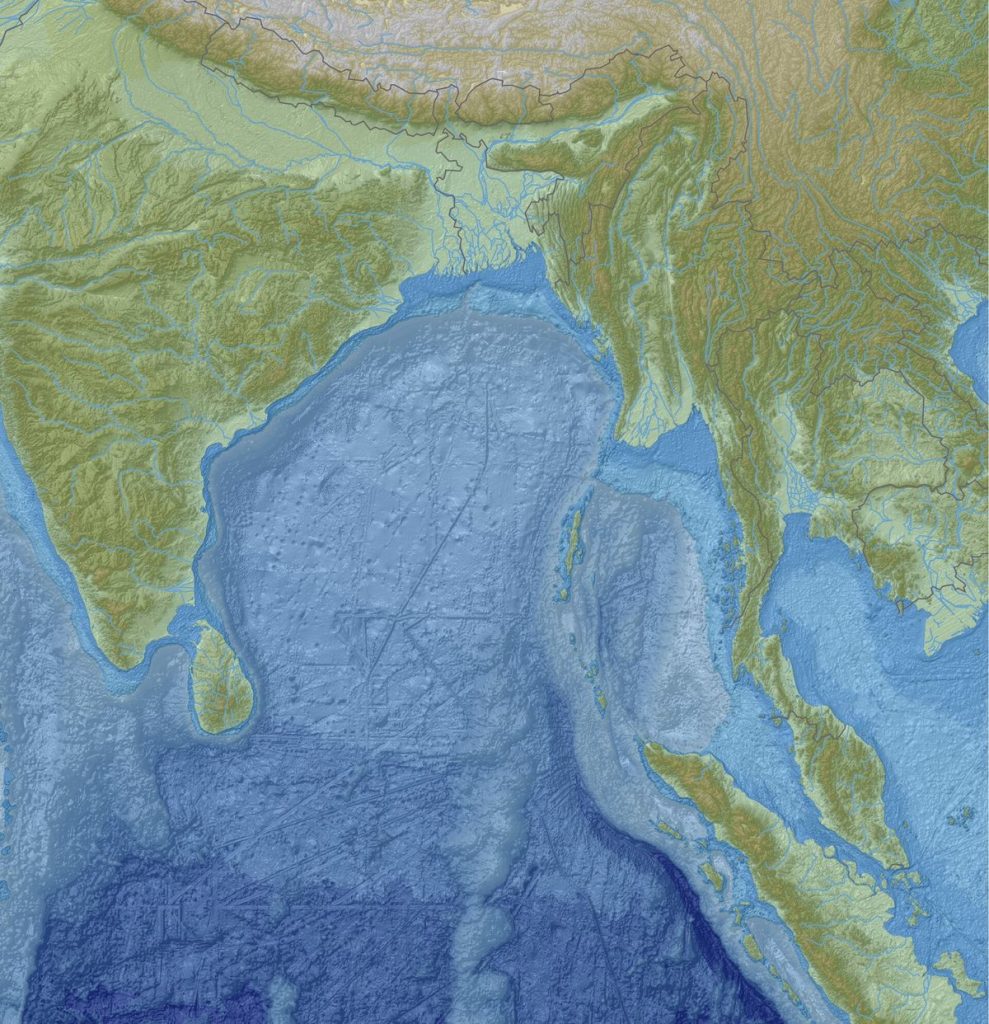
Relief map of the Bay of Bengal and the countries around it. Map: Tausheef Hassan Auntu, public domain, via Wikimedia Commons.
BIMSTEC began with six sectors in 1998 and grew to fourteen by 2014. The Fifth Summit in 2022 streamlined them into seven sectors with sub-sectors (BIMSTEC sectors page):
Sector
Sub-sectors
1. Trade, Investment and Development
Blue Economy added as a sub-sector in 2023
2. Environment and Climate Change
—
3. Security
Counter-Terrorism and Transnational Crime; Disaster Management; Energy
4. Agriculture and Food Security
Agriculture; Fisheries and Livestock (led by Myanmar)
5. People-to-People Contact
Culture; Tourism; People-to-People Contact
6. Science, Technology and Innovation
Technology; Health; Human Resource Development
7. Connectivity
—
This week’s news fits neatly: the oil spill guidelines fall under Security and the Blue Economy, the tourism circuits under People-to-People Contact, and the health ministers’ meeting under Science, Technology and Innovation.
What did the Sixth BIMSTEC Summit decide?
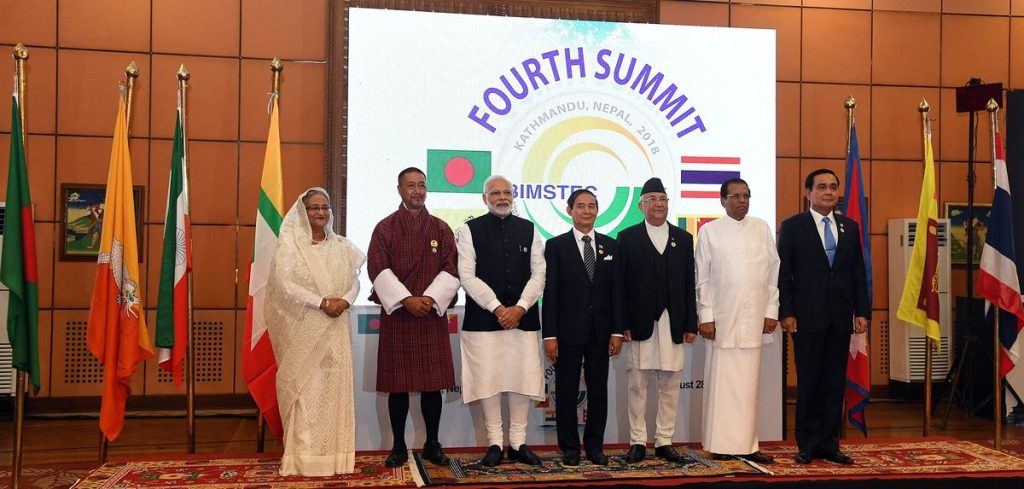
Leaders at the closing session of the Fourth BIMSTEC Summit in Kathmandu, 31 August 2018. Photo: Press Information Department, Bangladesh, public domain, via Wikimedia Commons.
The Sixth Summit in Bangkok on 4 April 2025, themed “Prosperous, Resilient and Open BIMSTEC”, is the most recent leaders’ meeting. Its declaration committed members to:
adopt the BIMSTEC Bangkok Vision 2030, a plan for a “prosperous, resilient and open” region over the coming decade;
adopt Rules of Procedure for BIMSTEC mechanisms, and act on the report of the Eminent Persons’ Group on the future of BIMSTEC;
welcome the signing of the Agreement on Maritime Transport Cooperation, to improve shipping links and port investment;
work towards cross-border payments and trade in local currencies, noting that some members already use India’s UPI;
set up BIMSTEC Centres of Excellence: in India for Disaster Management, Agriculture and Maritime Transport, and in Thailand for Tropical Medicine and Public Audit;
hand over the chair from Thailand to Bangladesh.
Why does BIMSTEC matter for India?
For India, BIMSTEC sits where two foreign policy ideas meet: Neighbourhood First and Act East. It links India’s eastern neighbours to Southeast Asia without depending on SAARC, whose summit has not met since 2014.
Connectivity: the Bay of Bengal is the natural route from India’s North-East and eastern ports to Myanmar and Thailand.
Maritime security: piracy, illegal fishing, oil spills and disasters all cross borders; this week’s guidelines are a practical step.
Disaster response: the region faces cyclones and earthquakes; India hosts the planned Centre of Excellence on Disaster Management.
Balancing other powers: a working regional group gives smaller neighbours options and keeps India central to the Bay.
The limits are just as real. Summits are infrequent, a free trade agreement first discussed in 2004 is still not in force, and political strains between members, including India–Bangladesh ties, slow decisions. Our explainer on the Ganga Water Treaty covers one such strain.
How is BIMSTEC different from SAARC and ASEAN?
Students often mix up India’s regional groupings. This comparison helps:
Point
BIMSTEC
SAARC
ASEAN
Founded
1997 (Bangkok Declaration)
1985
1967
Secretariat
Dhaka
Kathmandu
Jakarta
Members
7
8
11
Includes Pakistan?
No
Yes
No
India’s role
Founding member
Founding member
Dialogue and Comprehensive Strategic Partner, not a member
Prelims (GS Paper I): remember the founding date (6 June 1997), the original name (BIST-EC), the seven members, the Secretariat (Dhaka, 2014), the Charter (Colombo, 2022), the seven sectors and the current chair (Bangladesh). Statement questions often test whether Pakistan, Maldives or Afghanistan are members. They are not.
Mains (GS Paper II): try this 150-word question:
“BIMSTEC has emerged as India’s preferred platform for regional cooperation in South Asia.” Examine its potential and its limitations.
Structure: what BIMSTEC is → why India prefers it to SAARC → recent steps (Charter, seven sectors, Bangkok Vision 2030, maritime cooperation) → limitations (slow summits, no FTA, bilateral strains) → way forward.
The comparison table and practice question are Prayag IAS Academy’s own. Images are from Wikimedia Commons under GODL-India or in the public domain; credits are in each caption.
BIMSTEC was founded on 6 June 1997 and has seven members, a Secretariat in Dhaka and seven sectors. This week’s news, the Sixth Summit outcomes, a SAARC-ASEAN comparison and UPSC notes, with Hindi quick facts.
COP31 in Antalya ended on 22 November 2026 without adopting the Antalya Pact. Why it failed, what was agreed, what India said and the key terms for UPSC.
UPSC CSE 2026 interviews run from 7 December 2026 to 12 February 2027 for 2,526 candidates. How to find your date, reporting time, e-Summon, travel allowance and a plan for the weeks left.
The 1996 Ganga Water Treaty with Bangladesh expires on 12 December 2026. The Farakka sharing formula, what happens if it lapses, what each side wants, and how to prepare it for UPSC.