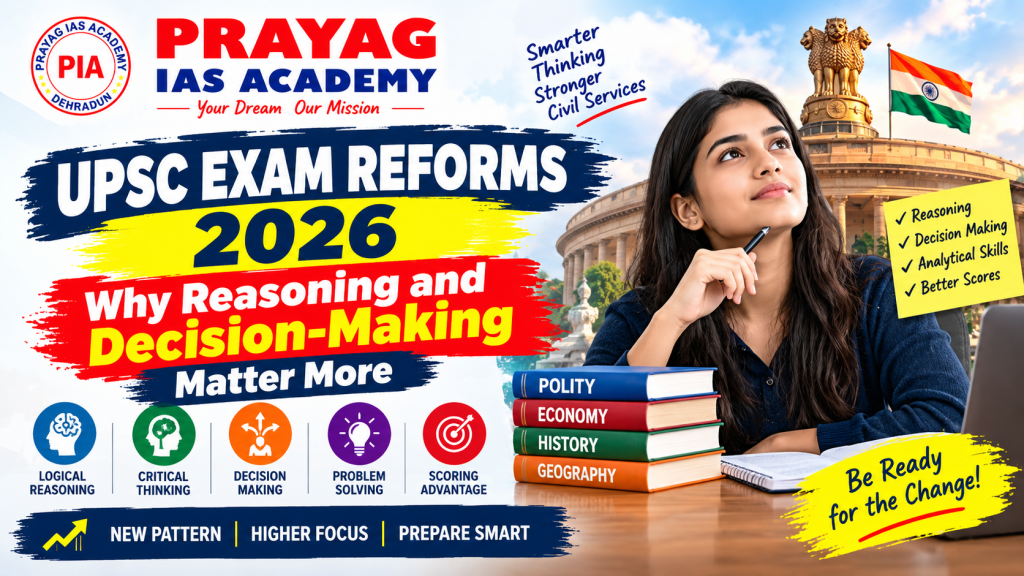
UPSC Exam Reforms 2026: Why Reasoning and Decision-Making Matter More
The UPSC Exam Reforms 2026 introduce a paradigm shift from conventional knowledge-based assessment to capability-based evaluation. The revised framework emphasizes analytical prowess, decision-making acumen, and real-world problem-solving ability over memorization. These changes reflect the evolving demands of civil administration in the 21st century, where officers must navigate complex socio-economic challenges with wisdom and judgment.
The new structure includes modified question patterns in the prelims, restructured mains categories, and enhanced interview protocols that prioritize spontaneous thinking and adaptive reasoning. This evolution in UPSC Exam Reforms 2026 signals that traditional coaching methods must be supplemented with contemporary analytical training.
Why UPSC Is Focusing More on Reasoning and Decision-Making
Modern governance requires administrators who can think critically and make informed decisions under pressure. The UPSC Exam Reforms 2026 acknowledge this reality by prioritizing reasoning and decision-making capabilities. The commission recognizes that a bureaucrat’s success is not measured by how much they remember, but by how wisely they apply knowledge to real-world scenarios.
Contemporary challenges—climate change, digital governance, public health crises, and social inequality—demand leaders who can reason through unprecedented situations. The UPSC’s shift toward reasoning skills reflects this understanding. Explore Prayag IAS Academy’s comprehensive UPSC Foundation program designed to build these critical thinking capabilities alongside subject knowledge.
What Does "Spontaneous Thinking" Mean for UPSC Aspirants?
Spontaneous thinking refers to the ability to respond intelligently to novel questions without relying on memorized answers. The UPSC Exam Reforms 2026 test this capacity through scenario-based questions, ethical dilemmas, and situational analysis questions. This is particularly evident in the General Studies papers where abstract and conceptual thinking takes precedence over factual recall.
Spontaneous thinking demands that aspirants understand the “why” behind concepts rather than just the “what.” For instance, instead of memorizing constitutional provisions, candidates must grasp the underlying philosophy of federalism and explain how it applies to contemporary disputes. This approach ensures that civil servants can navigate unforeseen administrative challenges with reasoning-driven solutions.
Reasoning Skills vs Rote Learning in UPSC Preparation
| Parameter | Traditional Rote Learning | Reasoning-Based Learning |
|---|
| Focus | Memorization of facts | Understanding concepts deeply |
| Question Response | Reproduces learned answers | Applies logic to new scenarios |
| Application | Limited to known questions | Adaptable to unknown questions |
| Long-term Retention | Requires constant review | Sustained through understanding |
| Administrative Effectiveness | Unreliable in novel situations | Effective in complex governance |
The UPSC Exam Reforms 2026 have made this distinction critical. Modern UPSC question patterns increasingly test reasoning over memorization. The Analytical Reasoning section in CSAT and the conceptual questions in General Studies papers demonstrate this shift. Aspirants must move beyond textbook learning to develop reasoning skills through case study analysis, mock debates, and real-world problem-solving exercises.
How Decision-Making Could Influence Future UPSC Assessment
Decision-making is becoming a cornerstone of UPSC Exam Reforms 2026. The Commission is incorporating questions that present administrative dilemmas requiring candidates to weigh competing interests and justify their choices. This reflects the reality that civil servants often face situations where all options have trade-offs.
Future UPSC assessments may include more scenario-based questions asking how aspirants would handle specific situations as district collectors, revenue officers, or policy advisors. This approach evaluates judgment, not just knowledge. The interview stage, already conversational, may become even more focused on decision-making scenarios. Candidates must practice articulating their reasoning clearly and defending their positions logically.
Impact of UPSC Reforms on Prelims Preparation
The prelims stage of UPSC Exam Reforms 2026 now incorporates more inference-based questions requiring aspirants to analyze passages, interpret data, and draw logical conclusions. Static knowledge alone is insufficient; candidates must develop the ability to reason through question stems and evaluate options critically.
The CSAT section has become increasingly logic-intensive, testing aptitude for systematic thinking rather than merely numerical skills. Current Affairs questions now often include analytical components asking “why” an event is significant rather than just “what” happened. This fundamental change requires aspirants to strengthen their engagement with daily current affairs through Prayag IAS Academy’s curated analysis.
Impact on UPSC Mains Answer Writing
UPSC Mains answer writing has become the crucial arena for demonstrating reasoning abilities. The UPSC Exam Reforms 2026 reward answers that showcase analytical frameworks, logical structures, and evidence-based arguments. Generic answers, regardless of comprehensiveness, score lower than concise, reasoned responses.
Examiners now explicitly look for:
- Logical flow: How well ideas connect and build upon each other
- Critical analysis: Examination of multiple perspectives before presenting conclusions
- Contextual application: Relating concepts to contemporary challenges
- Justified conclusions: Why the chosen position is reasonable and defensible
The traditional practice of writing lengthy factual answers no longer suffices. Success requires articulate reasoning, and Prayag IAS Academy’s specialized answer writing programs focus precisely on developing these evaluative skills through guided practice and expert feedback.
Role of Critical Thinking in UPSC Mains
Critical thinking is the foundation upon which UPSC Exam Reforms 2026 expectations are built. This involves questioning assumptions, examining evidence, considering alternative viewpoints, and reaching well-reasoned conclusions. The UPSC Mains, particularly in Ethics and General Studies Paper 4, explicitly test critical thinking abilities.
Case studies present dilemmas where aspirants must weigh ethical principles against practical constraints. Questions ask candidates to critique existing policies rather than merely explain them. This requires intellectual courage to challenge established thinking while maintaining rationality. Developing critical thinking demands exposure to diverse perspectives, which Prayag IAS Academy provides through expert faculty mentorship.
How Current Affairs Can Build Analytical Thinking
Current affairs is no longer just factual information to memorize; it’s a tool for developing analytical thinking. The UPSC Exam Reforms 2026 expect aspirants to understand why events matter, how they connect to larger themes, and what governance implications they carry. This analytical approach to current affairs strengthens reasoning abilities essential for the reformed examination.
Effective current affairs preparation now involves:
- Analyzing the root causes of events, not just describing them
- Connecting isolated incidents to broader policy frameworks
- Evaluating proposed solutions critically before accepting them
- Understanding multiple stakeholder perspectives on contentious issues
By engaging with current affairs analytically, aspirants simultaneously prepare for UPSC Exam Reforms 2026 and develop the judgment expected of civil servants.
UPSC Ethics and Real-World Decision-Making
Ethics and Integrity questions in UPSC Exam Reforms 2026 are increasingly scenario-based, presenting real administrative dilemmas. The Paper 4 (Ethics) no longer accepts theoretical answers; it demands reasoning about actual decision-making contexts where ethical principles conflict with operational pressures.
Consider an examiner’s question: “As a collector, you discover that a popular welfare scheme implementation is proceeding with procedural lapses. Stopping it would disappoint beneficiaries; continuing violates regulations. How would you proceed?” Such questions evaluate real-world decision-making ability and ethical judgment—exactly what the reformed UPSC assessment prioritizes.
Aspirants must practice articulating their reasoning in ethics answers, explaining not just what they would do but why, and acknowledging the legitimate concerns on all sides of the dilemma. This nuanced approach reflects the complexity of modern governance.
How Aspirants Can Develop Better Judgement Skills
Judgment develops through exposure to complex scenarios and guided reflection. To prepare effectively for UPSC Exam Reforms 2026, aspirants should:
- Engage in mock interviews: Practice responding to unexpected questions without preparation, simulating real decision-making pressure
- Study case studies: Analyze real administrative decisions, understanding the reasoning behind choices and evaluating their outcomes
- Participate in group discussions: Expose yourself to alternative viewpoints and learn to evaluate competing positions rationally
- Read widely: Beyond syllabus materials, explore literature, philosophy, and history to develop contextual understanding
- Seek mentorship: Work closely with experienced mentors who can challenge your reasoning and refine your judgment
Prayag IAS Academy’s personalized mentorship approach specifically addresses judgment development through one-on-one guidance and scenario-based training aligned with UPSC Exam Reforms 2026 expectations.
Common Preparation Mistakes in a Changing UPSC Exam
As UPSC Exam Reforms 2026 reshape expectations, certain traditional preparation mistakes become more consequential:
- Continuing rote memorization: Aspirants who memorize facts without understanding concepts fail to adapt to reasoning-based questions
- Neglecting answer writing practice: With emphasis on reasoned analysis, insufficient writing practice is a critical deficit
- Isolating subjects: Failing to see connections between disciplines and real-world applications limits analytical capacity
- Passive current affairs consumption: Reading news without analyzing its governance implications wastes preparation time
- Avoiding difficult topics: Aspirants who skip challenging conceptual areas cannot develop robust reasoning skills
Recognizing these mistakes and course-correcting ensures that preparation aligns with the reformed examination’s actual demands.
How Coaching and Mentorship Can Adapt to New UPSC Trends
Leading coaching institutes must evolve to support UPSC Exam Reforms 2026. Effective adaptation includes:
- Shifting curriculum focus: From memorization drills to analytical frameworks and problem-solving exercises
- Enhancing mentorship: Regular one-on-one sessions to evaluate reasoning abilities and guide judgment development
- Scenario-based training: Mock interviews, case study analysis, and ethical dilemma discussions
- Answer writing evaluation: Detailed feedback on logical structure, reasoning clarity, and argumentative strength
- Current affairs analysis: Moving beyond news reporting to governance-focused interpretation
Prayag IAS Academy, established in 2000, has adapted its curriculum and mentorship approach to emphasize analytical skills and judgment development, ensuring aspirants receive preparation aligned with UPSC Exam Reforms 2026 expectations. The academy’s focus on answer writing and personalized guidance directly addresses the reformed examination’s priorities.
UPSC 2027 Preparation Strategy After the 2026 Reform Discussions
Aspirants preparing for UPSC 2027 should adopt a strategy that fully embraces the lessons from UPSC Exam Reforms 2026:
- Foundation phase (Months 1-6): Build deep conceptual understanding through analytical study materials and guided discussions
- Application phase (Months 7-12): Practice applying knowledge to reasoning-based questions and scenario analysis
- Specialization phase (Months 13-18): Intensive answer writing and mock interview practice focusing on judgment demonstration
- Refinement phase (Months 19-24): Address weak reasoning areas and develop confidence in explaining complex positions
This approach ensures that preparation not only covers syllabus content but actively develops the reasoning and decision-making capabilities that UPSC Exam Reforms 2026 prioritize.
Conclusion
The UPSC Exam Reforms 2026 embody a clear philosophy: civil servants must be thinkers, not memorizers. They must make decisions under uncertainty, reasoning through competing priorities to find solutions that serve public interest. This fundamental reorientation demands that aspirants transform their approach to preparation. The emphasis on reasoning and decision-making is not merely a technical change to question patterns; it reflects a shift in what India’s civil services expect from their officers.
For aspirants committed to cracking the UPSC, adapting to these reforms is essential. The journey involves moving from passive consumption of information to active analytical engagement. It requires developing judgment through exposure to complex scenarios and diverse perspectives. It demands that aspirants learn to articulate reasoning clearly and defend positions thoughtfully.
Institutions like Prayag IAS Academy, with decades of experience in civil services coaching, are at the forefront of implementing preparation strategies aligned with UPSC Exam Reforms 2026. Their emphasis on personalized mentorship, answer writing excellence, and analytical thinking directly addresses the reformed examination’s priorities.
FAQs on UPSC Exam Reforms 2026